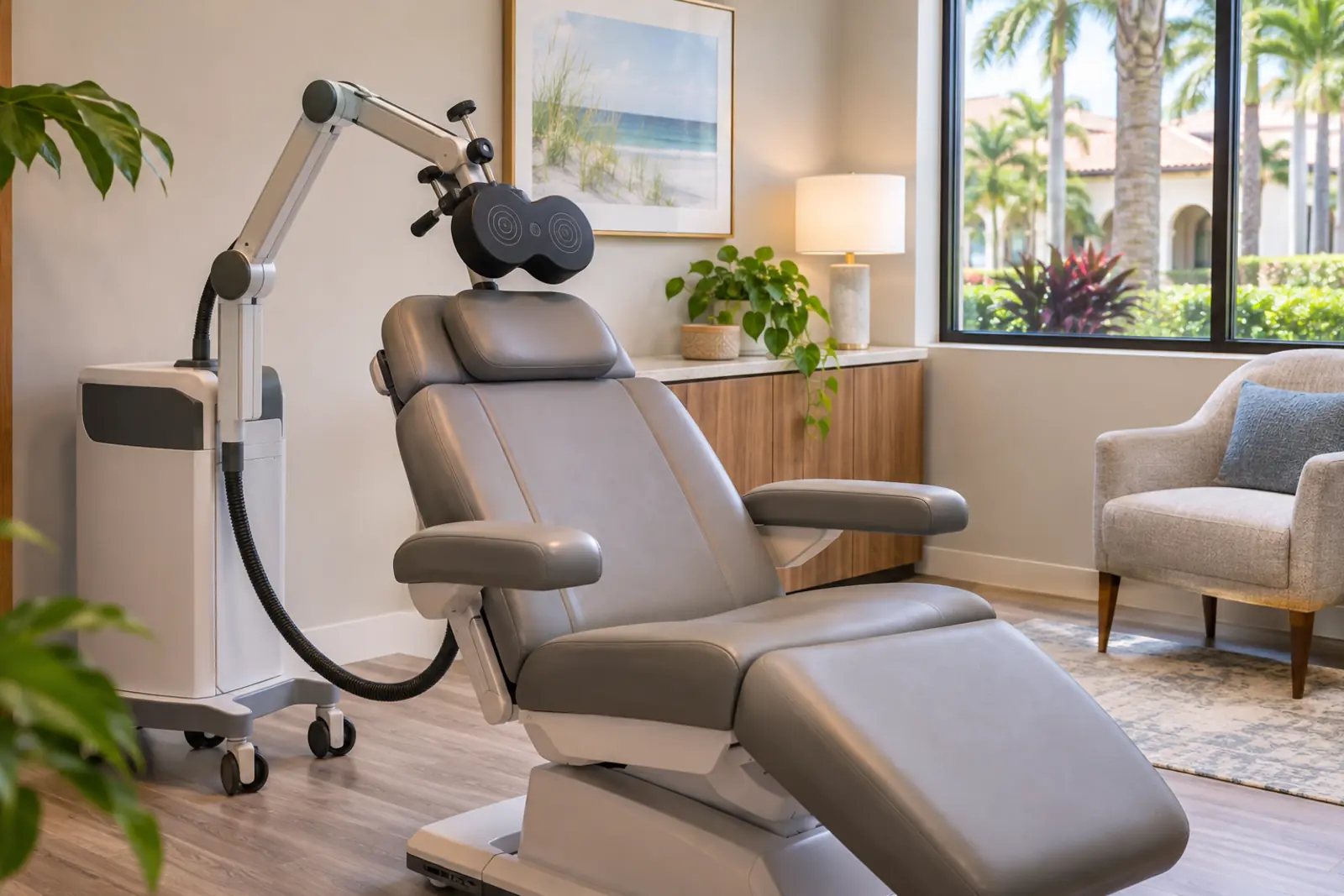
TMS therapy (transcranial magnetic stimulation) is a non-invasive brain stimulation treatment used in psychiatry. A coil held against the scalp delivers brief magnetic pulses that stimulate nerve cells in a targeted brain area, usually one linked to mood. No surgery or anaesthesia is involved, and you stay awake in a chair. It is best known as a treatment for depression that has not improved enough with medication. This page explains the basics in plain language so that a recommendation from a clinician, or a brochure from a provider, is easier to evaluate. It is general information, not medical advice.
TMS therapy explained in brief
- What it is: a repeated-pulse treatment, often called rTMS (repetitive transcranial magnetic stimulation), given in a clinic or office. The National Institute of Mental Health describes it as a noninvasive therapy that uses an electromagnet.
- What it does: the pulses are low intensity and induce weak electrical currents in nearby nerve cells.
- Who uses it: adults, and in some cases adolescents, whose condition has not responded well enough to other treatment, as decided with a psychiatrist.
- What it is not: it is not electroconvulsive therapy (ECT). It targets a specific brain site and does not need anaesthesia.
How does TMS therapy work?
A treatment coil placed against the scalp produces brief magnetic pulses that pass through the skull and activate nerve cells in a targeted area, most often a part of the prefrontal cortex linked to mood. Cleveland Clinic notes that, depending on the pulse pattern, TMS can help wake up underactive areas or calm overactive ones. Repeated sessions are thought to change activity in the networks connected to that area. Researchers are still refining the details of the mechanism, which is one reason a cautious provider will describe TMS as an evidence-supported option rather than a guaranteed fix.
What conditions is TMS used for?
The FDA has cleared particular TMS systems for major depressive disorder in adults, with later clearances for some devices covering anxious depression, obsessive-compulsive disorder and short-term smoking cessation, and for adolescents with depression on at least one system. NIMH reports that the adolescent clearance, for adjunctive treatment of depression, came in March 2024 and applies from age 15; TMS is not approved for children under 15. Clearances apply to specific devices and age groups. Use for other conditions, such as PTSD, ADHD or bipolar depression, is often described as off-label and is more likely to be excluded by insurers. The guides on treatment-resistant depression, OCD and PTSD go into each case. For a wider overview, see what TMS therapy is used for, and for younger patients the guide to TMS for teens and adolescents.
The depression-specific details, including how treatment is usually sequenced, are covered in the guide to TMS therapy for depression.
What an evaluation covers
- Diagnosis, symptom history and current severity, often with standard rating scales
- Earlier treatments: medications tried, doses, duration and response
- Medical history, including seizures, head injuries and any metal or electronic implants
- Current medications and substance use
- Practical limits such as transportation and work hours
What happens during TMS treatment?
Many standard protocols involve one session a day, five days a week, over several weeks, sometimes followed by a taper of less frequent sessions. NIMH describes a standard course as daily sessions, five days a week, for 4 to 6 weeks, and Cleveland Clinic puts a common depression course at about 30 to 36 sessions. At the first treatment visit the clinician typically finds the spot on the head that makes a thumb twitch, and sets the intensity from that. You sit in a chair, usually wear hearing protection, stay awake and can generally resume normal activities afterward.
How long is a TMS session?
Session length depends on the pulse pattern. NIMH gives a range of about 3 to 40 minutes. Cleveland Clinic lists conventional rTMS at roughly 20 to 40 minutes and theta-burst stimulation at roughly 3 to 10 minutes.
Are there faster schedules?
Accelerated protocols deliver several sessions in one day and can finish within about a week, according to NIMH. Their evidence is still developing, so ask what is known about the specific schedule on offer.
When do people notice a change?
Cleveland Clinic says improvement may appear within a couple of weeks. Response varies from person to person, and a clinician should review progress at set points rather than waiting for the course to end.
Is TMS therapy safe? Side effects and who should not have it
Headache and scalp discomfort are the most common effects and tend to ease over the first weeks. NIMH also lists muscle contraction or tingling in the scalp, jaw or face, lightheadedness and dizziness. A seizure is a rare but recognized risk, which is why screening matters. Cleveland Clinic describes seizure as the most serious side effect and "very rare", and states that TMS does not cause memory loss or thinking problems.
Screening focuses on metal and electronics near the coil. Cleveland Clinic lists cochlear implants, aneurysm clips or coils, implanted brain stimulators, metal plates and shrapnel in or near the head or neck, and pacemakers or defibrillators among the items that can rule TMS out, along with or a history of seizures or epilepsy, in which case medicines that raise seizure risk also matter. Most other metal, such as hip or knee replacements and dental fillings, is considered safe. The side effects and safety guide covers screening questions in more detail.
TMS therapy compared with ECT
ECT is a different treatment: it uses anaesthesia and is generally reserved for severe or urgent cases. TMS targets a specific brain site and needs no anaesthesia, but NIMH notes that it does not match ECT's therapeutic effects. A treating psychiatrist is the right person to weigh the two.
TMS therapy insurance and cost
Payers commonly require a diagnosis, documented medication trials and prior authorization. Fees and coverage differ by plan and provider, so verify both before starting. The cost and insurance guide offers a checklist of questions.
Questions to ask a provider
- Which TMS device and protocol will be used, and is it cleared for my condition and age?
- Who supervises treatment, and who handles medical questions between sessions?
- How is progress measured, and at what point would the plan be reviewed or changed?
- What does a full course cost if insurance does not cover it, and what is included?
- What are the options if I improve and then relapse? See the guide on maintenance and retreatment.
The guide on how to choose a TMS provider expands on these points.
How TMS fits with other care
TMS is usually discussed alongside, not instead of, psychotherapy and medication. It is also compared with esketamine and ketamine, which have their own comparison guide, and with electroconvulsive therapy, which is generally reserved for severe or urgent cases. A treating psychiatrist is the right person to weigh these.
Frequently Asked Questions
What does TMS stand for?
TMS stands for transcranial magnetic stimulation. "Transcranial" means through the skull, and the treatment uses magnetic pulses rather than medication or surgery. When pulses are repeated in a course of sessions it is often called rTMS.
Does TMS hurt?
Discomfort is usually mild. NIMH lists discomfort where the coil sits, tingling or muscle contraction in the scalp, jaw or face, and mild headache as the common effects, and Cleveland Clinic describes the common effects as usually mild.
Is TMS the same as ECT?
No. ECT uses anaesthesia and is generally reserved for severe or urgent cases. TMS targets a specific brain site, needs no anaesthesia, and you can usually return to normal activities straight after a session.
How many TMS sessions are needed?
A common schedule is daily sessions, five days a week, for 4 to 6 weeks, which Cleveland Clinic puts at about 30 to 36 sessions for depression. Accelerated programmes pack sessions into roughly a week. Some people have maintenance sessions later.
Is TMS therapy available in Spanish?
The same overview is available in Spanish in the guide Terapia TMS: qué es, cómo funciona y qué esperar.
If you are in crisis, call or text 988, the US Suicide & Crisis Lifeline, or call 911.